

REV008
Nickolas Mohanna
“An extremely unconventional display of unparalleled talent, Smoke comes as an art edition of 100 copies with a book and poster, and it’s pretty likely a project like this will sell out quick if it hasn’t already.”
Take Effect
Tracks
- Tower
- Circuit Rider
- Plague
- Spectra
- Fugitive
- Plague II
- Axis
- Visage
- HWY
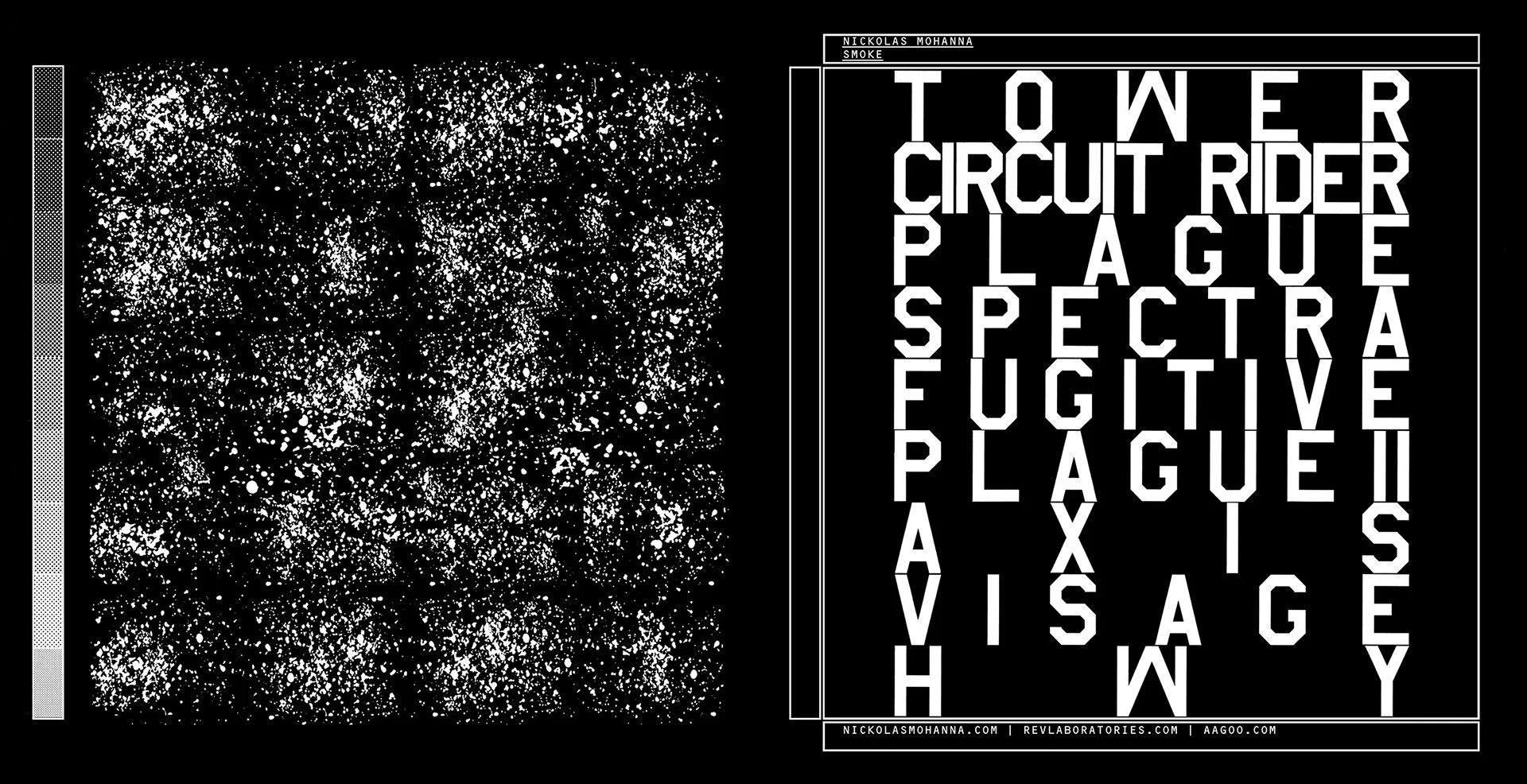
NICKOLAS MOHANNA - SMOKE
Catalogue
REV008|AGO113
Formats
12” vinyl + poster + zine
Released
April 24, 2019
Recorded and mixed
at ZIG Systems, Bronx, NY
Mastered and cut
by Josh Bonati at Bonati Mastering,
Brooklyn NY
Smoke is a limited art edition of 100 copies, which also includes a poster and zine
Smoke is a selection of new work by the artist and composer Nickolas Mohanna. The instrumental work could be seen as more of a departure from more digitally rendered compositions, and takes its form from acoustically derived tools. Mohanna builds a new shape in Smoke, to translate his ideas via a longing to find a more tactile physicality in composing; digging the fingers deep into the strings of the instrument, rough hewn arpeggios and angular note bends sit within a weight of dissonance that carry the pieces into shifting musical topographies. In these tracks, percussive elements intersect with acoustic strings that are used as both neutral sound sources and examinations of melodic contour; to produce timbres and tones inside a mélange of noise fields that trigger more exploratory harmonic forms and polyphonic impressions.
Conversation
This is a conversation back in january 2018, it was published online at the platform North Of The Internet.
Bas Mantel spoke with Nickolas Mohanna about the impermanence of existence, the value of physical media, the immensity of humanity, activating dimensional shifts and generating electricity from a lemon..
NOTI by Bas Mantel
Week 04
January 25, 2018
“I hope more young people will deny the virtual requests from culture and opt for something more palpable, trying to take in the work of the artist through whatever medium was intended.”
Nickolas Mohanna
Boundaries
Cut.
Life
Disk.
Yellow
Bells.
Ceremony
Round.
Cell
Split.
Space
Tube.
Bas presented Nickolas with 30 words in no particular order and asked what immediately came to mind when he read each one.
Water
Freedom.
Parallax
Kick.
Sound
Gnarly.
Fire
Burial.
Light
Rage.
Ruins
Blue.
Mind
Swell.
Grow
Lateral.
Death
Mask.
Land
Strike.
Pole
Elastic.
Animal
Tongue.
Rules
Language.
Everything
Horizon.
Particles
Body.
Territory
Sanction.
Dream
Fluid.
Secret
Terror.
Grain
Chemical.
Void
Highway.
River
East.
Dark
Mold.
Creator
Submission.
Matter
Beam.
A1
Nickolas Mohanna
Yes, and next time we also need to touch on Provo, Metahaven and the expansive Bas Jan Ader — but we could only cover so much in those eight hours!
In the spirit of these people mentioned, in my creative process, I stay close to this idea of transforming language into objects. The forms are pushed into a fullness and later reduced to nothing, or vice versa. Many of my pieces, mostly drawings, can begin in the domain of design as fractured arrangements that are sculpted into a concise shape, glyph or line. When I work with a sound piece, I proceed in the same manner to understand the body of sound within blending of timbres and noise fields. Some of the visuals also have a next life, as a kind of graphic architecture translated into sound or simply existing as a working sketch. One may happen before the other, with the process being akin to the printing process, when you need to understand the frame or type in reverse to achieve a final composition.
My publishing project is entirely collaborative and a synthesis between different arts — it is always thrilling to work with another artist’s vision. I just love working through the endless permutations in the creation of a book or artist object. There are so many incidentals that occur that give new meaning to the construction. Some of the artists have used objects or language as a mechanism to work out themes of memory, history and illusion. Thus far, the projects selected are the result of a desire of exhaustivity confronted with the impermanence of existence. In one book project, a span of 10 years in the artist’s life is compressed and processed into one year as a book of stories.
So, the design for this was about having an organizational system delicate enough as to not divert the concept. Another project was a novella involving the twelve sides of a green dodecahedron. Each side represented a chapter and the path the convex form takes through different time periods.
Q1
Bas Mantel
When we met in Amsterdam in December 2017, we spoke about the power of words and typography, as well as Dutch forms/designers like De Stijl, Piet Zwart, Dick Elfers and Experimental Jetset. All communicate(d) their messages with unique aesthetics and concepts. Could you describe your vision of the power of words and typography? How do you use language and words in your work as an audiovisual artist?
Q2
What will be the future format or source for music and sound, beyond physical objects like LPs, CDs, cassettes and streaming services like Spotify? Is the relation between image and sound still there? What makes the relation between these two relevant or irrelevant? Will this new format be physical in nature?
A2
I feel the most rewarding physical relationship one should have with art is in a tangible way; through performance, examining the grooves of a record, recognizing the weight of a steel, or running a hand over the grain of wood only to get a splinter. The future of the format in the virtual stream will just become a more advanced data vacuum onto whatever the host may be, which is the consumer.
I think in the end, it’s particular to each audience and relative to the art being produced at any moment in time. It’s how the idea is best expressed, and this is specific in each medium or format. As the recorded format becomes more virtually dependent upon the ping of an algorithmic pop-up, like everything else in our day-to-day reality, I only hope more young people (like mine) will deny the virtual requests from culture and opt for something more palpable, trying to take in the work of the artist through whatever medium was intended for the piece.
I’m drawn to performances that have a direct dialogue with the architecture of a space. This is always striking in the details. Within the interaction of music, vinyl and cassette sales have been steadily increasing for years, so perhaps this interest will continue to grow. With streaming, time will only tell. I guess we first need to consider or be suspicious of how much one even consumes and can conceivably enjoy, given the excess that’s being injected into hard drives, never to be heard.
Q3
What is your favourite time of the day concerning the amount of daylight in the atmosphere? Do you have a specific reason for this time of the day?
A3
Daybreak, maybe because I rarely experience it, which makes it more curious. When it does happen, the moment becomes more about the silence that’s about to be broken.
My mind is always full; steeped in the passing conversations of the ever changing bleeding edge of neo-capitalist simulacrum; dark flow capital and decaying infrastructures.
“What more do you need? Ideas and materials are in the streets!”
Nickolas Mohanna
Q4
Right now, you live in New York. You told me that you have lived in Nebraska and California as well. I can imagine that each of these places with their creative scenes and energy had a different influences on you. Could you describe what questions each of these places asked you when you were there? In what state of mind were you? Did you reveal some of these questions or answers in your work?
A4
Yes, born and raised on the Plains. Omaha was very different when I was there, as there were not so many opportunities available at the time in the visual arts compared to other large cities. The music community was very active with a scrappy “do it yourself” mentality, though I was mostly an outsider when it was all bubbling to the surface. I was interested in other things at the time, mostly in the arts like filmmaking, but heavily into politics, sustainable ecology, hacking and activism.
So, since I wanted a garden year round and I was fairly good with an axe, I jumped on a bus to the Pacific Rim. I finally settled in San Francisco and was engaged in a very supportive community. Most days I would just sit and visit people at places like Adobe Bookshop or Luggage Store Gallery. Many of these people were artists or drifters hanging out. More often than not, I would meet someone whose practice centered on an interdisciplinarity of the world, so I connected to this method of working very much.
I began to produce works that were interchangeably related to one another. I did visual work in the form of drawing or video, which became intricate or meditative where it was about experiencing the duration of time, while others were working sketches, but all inherently linked to sound composition or modes of technology when the tools are devised by the maker, either by chance or in a systemic way. Some of these experiments later grew into conceptual documents in the form of artist books and then later into collaborative publishing. Fast forward to now, living and working in New York for 10 years, I’ve also had many of the same experiences that have informed my practice. Walking the streets, I still have the same shot in the arm as when I first arrived; humanity is immense and the compassion for others is like no other place. My mind is always full; steeped in the passing conversations of the ever changing bleeding edge of neo-capitalist simulacrum; dark flow capital and decaying infrastructures. What more do you need? Ideas and materials are in the streets!
Q5
If the world existed in monochromatic black and white and you had the choice to pick one thing you could see in full color, what would that be?
A5
Lemons. I’m keen on the practicality of them. I mean, you can generate electricity from them, drink them and then zest your cookies!
“I try to suspend what I believe about the “now” in this world, peeling off the self and understanding the infinite interconnectivity and void within.”
Nickolas Mohanna
Q6
What does time mean in human existence — not understood as a specific philosophical category, but as an inner, psychological dimension that gives direction and form to individual existence? What does this subjective and individual experience of time imply for film art? These questions form the basis for the film art of Tarkovsky, so, according to Tarkovsky himself: How do you relate to these questions in your own work? What does time mean to you? What do dimensions mean to you? What does memory mean to you?
A6
A vessel of events; a container of my lived experiences but I need to be fully aware of the now to understand the past and the future. I try to suspend what I believe about the “now” in this world, peeling off the self and understanding the infinite interconnectivity and void within — which is myself asking the question, “What the fuck are we doing here?
I feel like what Tarkovsky was doing with temporal harmony or rhythm has inspired many of my more long-form pieces. The visual themes that unfold and guide the viewer through a kind of infinity tunnel is something I can relate to in the creation process. There is this mise-en-scène to composing; certain tones are more lit or colored than others and an improvised fusion occurs. I think he was able to craft these immersive environments in the arrangement of natural landscapes, etc. when the shots are joined together organically over time.
In some of the pieces I work on, I choose a patchwork of sounds that extract nature’s totality in that way, where time is present in the field of noise but I arrange the tones in a way that can go beyond just the listening experience, to exist in another form. Sounds become visible while the mind and body activate this immersive dimensional shift within the aether of the piece. Channeling into the red!
Q7
Finally, could you draw us a map of the all the places of the world where you have been?
A7
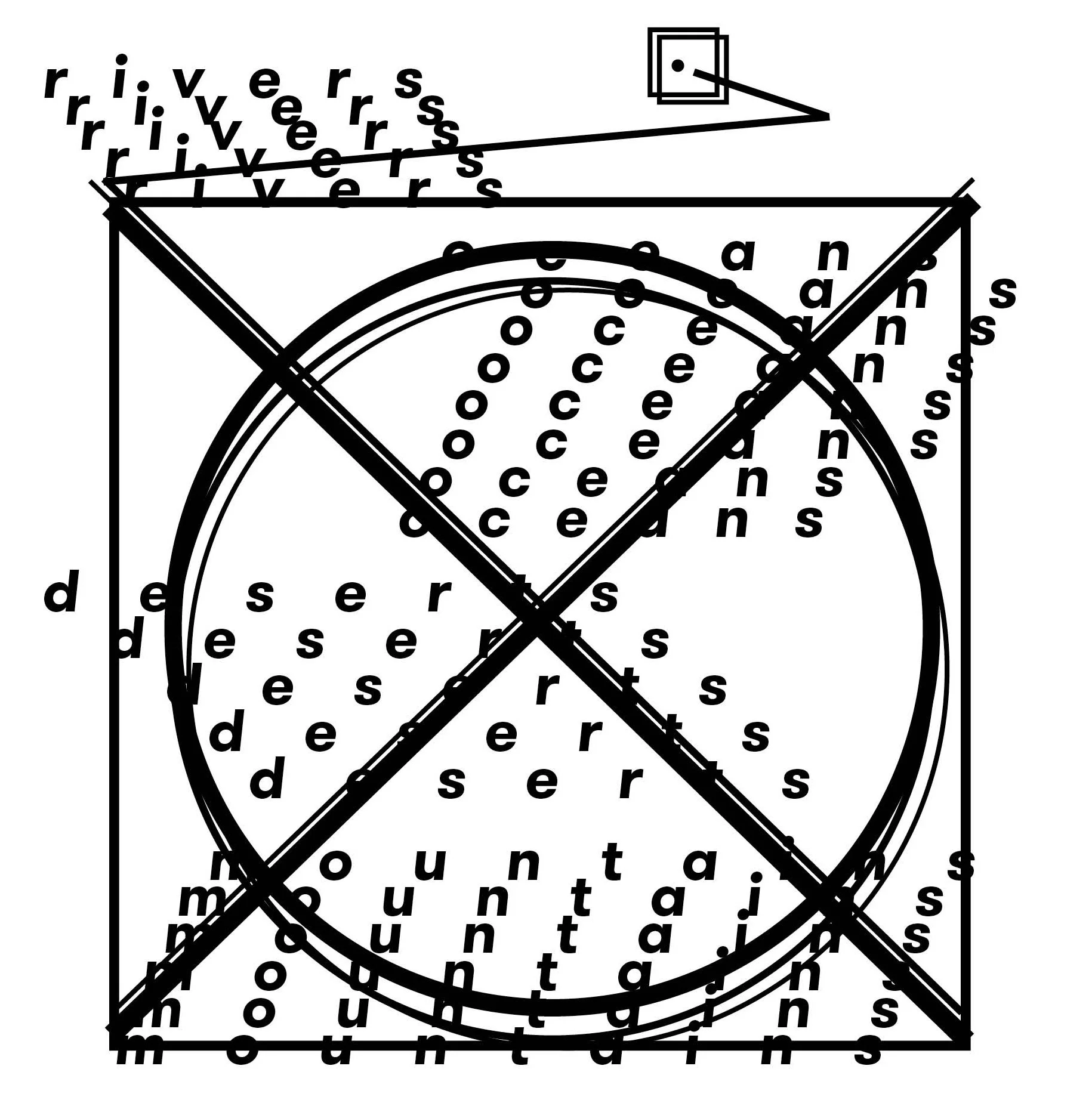
Thank you.
North of the Internet was a website that featured unique conversations with creators all over the world. The site aimed to defy music journalism standards by encouraging interviewees to interview others in return, resulting in an unprecedented network of interactions.
North of the internet has now transformed into label and publishing platform Computer Students™
TOWER
Official video
Directed by Bas Mantel
Music by Nickolas Mohanna